A Checklist for Lightweight Kitchen Tools in a Tiny Kitchen
Tiny kitchens rarely fail for want of equipment. They fail because the equipment was chosen for a different room: deeper cabinets, a wider counter, a pantry down the hall. That is how a compact kitchen ends up with three frying pans that stack badly, a stand mixer pushed under the sink, and a drawer that will not quite close.
The remedy is not bare minimalism. It is a set of tools light enough to lift with one hand, small enough to store where you can see them, and flexible enough to cover the cooking you actually do on a normal Tuesday. The checklist below runs zone by zone, because in a small kitchen prep, cooking and washing overlap, and each item has to earn the space it takes from the others.
Three Tests Before Anything Comes Home
Every tool mentioned below has to pass the same three questions. Ask them in the shop, or at the table before you open the box.
- The one-hand test. Can you lift it, use it and put it away with one hand while the other holds a pan? If it needs two hands to move, it will stay exactly where it lands and become an obstacle.
- The home test. Name the shelf, hook or drawer slot it will occupy. "I'll find a spot" is the sentence that fills kitchen counters.
- The job test. Write down what it does that nothing you own already does. One clear extra job is enough. Two vague ones are not.
The Prep Zone: Blades, Boards and Bowls
Prep is where a tiny kitchen either flows or jams. Keep the tools few, and keep them where your hands already go.
Knives and boards
Two knives are usually enough: a 20 cm chef's knife of reasonable weight, and a small serrated one for bread and tomatoes. A light blade in the 150 to 200 g range is easier to control than a heavy one and less tiring over a long chopping session. Add a peeler that fits your grip and skip the rest of the block.
Boards matter more than people expect. Two thin boards, one for raw meat and one for everything else, are better than one thick block: they are lighter, easier to wash, and can stand on edge behind the sink or slide into a narrow slot. A flexible folding board takes almost no room and is handy when the counter has disappeared under ingredients.
Measuring and mixing
Choose a nesting set of mixing bowls with flat bases so they sit steady and stack inside each other. Glass is heavy; thin stainless or food-grade silicone nests tighter. For measuring, one heatproof jug plus a set of nesting spoons covers most cooking, and a slim digital scale that stands on its edge takes less depth than the bowl-shaped kind.
The Countertop: What Deserves Permanent Space
The counter is the most valuable surface in the flat, so treat it as a lease you rarely grant. Anything left out should be used at least once a day, or be beautiful enough to justify itself. Usually that means a kettle, a small board or trivet, and not much else.
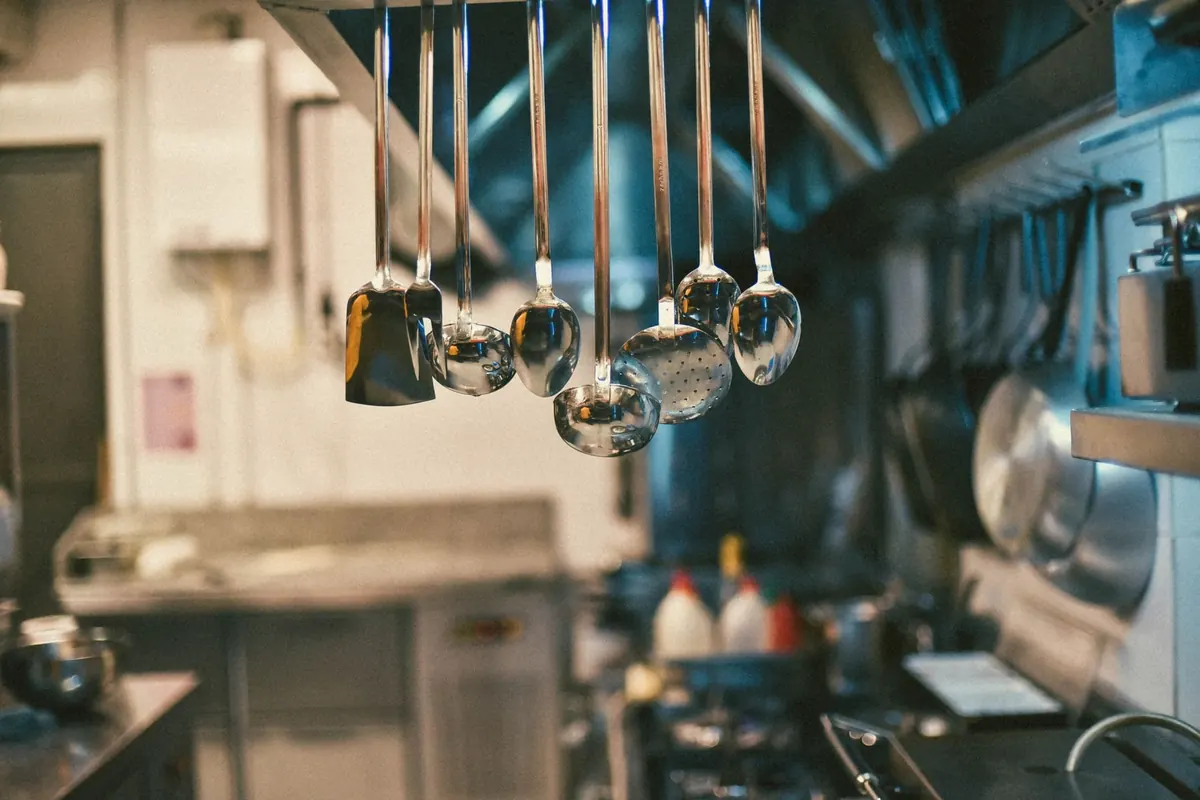
A compact kettle boils faster than you expect and is far lighter to pour when full than a large one. A two-slot toaster takes a fraction of the footprint of a four-slot model, and the oven grill covers the rest. Instead of a utensil crock, hang a short rail or a row of hooks on the wall or the side of a cabinet and let the tools dangle: spatula, ladle, tongs, strainer. This one change frees a surprising amount of counter and keeps handles within reach.
Cookware That Nests, Stacks and Lifts
Aim for three pieces that cover most meals: a frying pan around 24 cm, a saucepan of two to three litres, and a wider sauté pan or pot with a lid. Choose pans with straightish sides so they nest cleanly, and check that lids can be stored on the pan itself rather than sliding around a drawer.
Weight is the honest trade-off. Cast iron sears beautifully but a full-size skillet is a two-hand lift, especially full. If you want that heat, keep one small cast-iron pan and accept its weight; otherwise light aluminium or carbon steel will be kinder to your wrists and easier to hang. Be wary of very cheap non-stick pans that warp on the first high heat, and of detachable handles that wobble once they have been through a few hundred washes. A folding steamer insert and a lid that fits two pans earn their keep far more than a specialty pan used twice a year.
Washing, Storing and the Unglamorous Half
Half of a small kitchen is logistics, and that is where the space leaks. These are the items that quietly give it back:
- A folding dish rack that goes flat when the dishes are away.
- A colander that collapses or nests inside the saucepan you already own.
- Square airtight containers, which use shelf space far better than round ones and nest when empty.
- A sink caddy that hangs over the divider instead of standing on the drainer.
- A refillable dish brush with a long handle, plus a couple of washable cloths instead of a fat roll of paper towels.
- A slim pedal bin that fits beside the counter rather than in front of it.
Before buying any of these, empty one cabinet completely and look at what is actually in there. Duplicates and single-use gadgets are usually the reason the new container has nowhere to go.
Small Appliances: Buy Fewer, Use Them More
Appliances are where tiny kitchens lose the most room, because each one claims a permanent home and does one thing. Ask a blunt question before plugging anything in: what does this do that a pan, a knife or a bowl cannot? A stick blender passes, since it lives in a drawer and blends soup in the pot. A full-size blender often does not, unless you make smoothies daily.
Hand mixers beat stand mixers for occasional baking. A compact food processor is worth it if you cook for one or two people and chop a lot; skip it if you cook in bigger batches. And leave single-task machines like egg boilers or one-shape sandwich presses on the shelf. A simple rule: if it cannot replace two other things, it has to be used weekly.
The Walk-Through Checklist
Work through one zone at a time rather than reorganising everything in a weekend. Take a photograph of each shelf before you start, and keep a bag for donations beside you as you go.
- Prep: chef's knife, small serrated knife, peeler, two thin boards, nesting bowls, jug, nesting spoons, slim scale.
- Counter: compact kettle, two-slot toaster, wall rail with four or five hanging tools.
- Cooking: 24 cm frying pan, 2 to 3 litre saucepan with lid, sauté pan, folding steamer, two heatproof mats.
- Washing: folding rack, collapsible colander, hanging sink caddy, brush, cloths.
- Storing: matching square containers in two or three sizes, one slim bin, and nothing that does not fit a stated home.
Then test the result for a week. If something has not moved from its slot by Sunday, it was never a tool, just an occupant. Clear it out, and the kitchen you already have will feel a little larger.
Photo: Cihan Yüce / Pexels